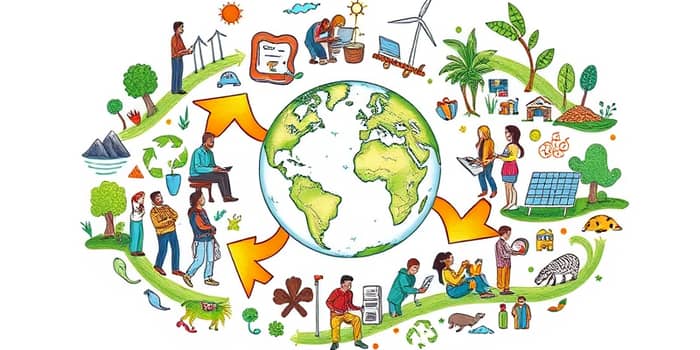
In an era of mounting environmental challenges and resource scarcity, the circular economy emerges as a beacon of hope. It offers a transformative approach that redefines value creation, drives innovation, and secures long-term resilience. This article delves deep into the principles, benefits, business models, investment landscape, and opportunities of the circular economy, equipping you with insights to make informed decisions and spark meaningful change.
The traditional linear economy follows a “take, make, dispose” pattern, leading to excessive waste and environmental degradation. By contrast, the circular economy is an economic model focused on eliminating waste and continual use of resources. It operates on three fundamental principles:
By embedding these principles into product lifecycles, businesses can achieve greater resilience, reduce costs, and contribute to a healthier planet.
Several factors are propelling the shift toward a circular model. Rapidly growing populations—projected to reach 9.8 billion by 2050—are straining finite resources. At the same time, environmental urgency demands substantial greenhouse gas reductions. Circular practices have the potential to slash emissions across sectors by up to 39%. Furthermore, economic volatility underscores the need for resource efficiency and waste minimization to stabilize supply chains and reduce exposure to material price shocks.
Governments and corporations alike are recognizing that circularity is not just an environmental imperative but also a strategic economic advantage. From policy incentives such as the EU Circular Economy Action Plan to corporate commitments by Unilever and Philips, momentum is building globally.
The transition to circular models yields profound benefits across environmental, economic, and social dimensions.
These advantages translate into tangible outcomes: almost 100% material recovery in certain systems, resilient local economies, and enhanced public well-being.
Organizations can adopt multiple strategies to participate in the circular economy. The OECD and Ellen MacArthur Foundation categorize these into five core models:
Each model addresses different stages of the product lifecycle, allowing companies to tailor solutions to their operational context.
Real-world examples illustrate how circular models drive impact:
Globechain operates a B2B reuse marketplace where companies list redundant assets. Other organizations claim and repurpose these items, reducing waste and cutting procurement costs.
H&M x I:CO collected over 29,000 tonnes of textiles in 2019 for resale, recycling, or upcycling, demonstrating scalable closed-loop fashion initiatives.
Protix, backed by a €35 million investment, converts food waste into insect protein for animal feed, addressing waste management and sustainable protein supply simultaneously.
Circos offers a baby clothing rental subscription, cleaning and redistributing garments when they outgrow them, maximizing material use and customer value.
Meanwhile, Plus Pack x Circqle delivers packaging-as-a-service with digital tracking, reducing CO₂ emissions by up to 60% compared to single-use packaging.
Investor interest in circular startups and technologies is surging. Companies like Protix and Mr Green Africa have secured major funding rounds to expand insect protein facilities and plastics recycling in East Africa, respectively.
Key market drivers include policy incentives, evolving consumer preferences for sustainable products, and the financial appeal of investment in circular models. Early adopters gain first-mover advantages, stronger brand reputation, and regulatory compliance readiness.
Despite clear benefits, scaling circular initiatives presents challenges. System complexity demands reengineering product design, supply chains, and waste management infrastructure. High upfront costs and uncertain ROI can deter investors without clear circularity metrics.
Addressing these obstacles requires collaboration across stakeholders—companies, governments, and communities—to develop supportive policies, standardized impact assessment frameworks, and targeted financial instruments.
Looking ahead, digital innovations will play a pivotal role. Digital tracking and optimization using IoT and AI can streamline material flows and forecast demand, enhancing repair schedules and resource recovery.
Emerging revenue streams—such as subscription services, refurbishment centers, and secondary material marketplaces—will reshape post-sale economics. As consumers increasingly prioritize sustainability, circular offerings align with net-zero commitments and global development goals.
The circular economy is more than a trend—it is a strategic imperative for businesses, investors, and societies. By prioritizing resource conservation, innovative business models, and collaborative ecosystems, we can unlock tremendous environmental and economic value.
Now is the moment to embrace circularity: reimagine product lifecycles, foster regenerative practices, and direct capital toward sustainable solutions. Together, we can build a future where prosperity thrives in harmony with the planet.
References